Bringing Your Dog to Kentucky State Parks: Leash Rules and No-Go Areas
A dog can make a Kentucky State Park trip more enjoyable, but pet access is not the same everywhere. The main challenge is planning a route that respects the leash requirement while avoiding places where pets are restricted. Here’s how to check outdoor areas, trails, beaches, historic sites, campgrounds, and lodging before you set out with your dog.
The leash rule is the starting point
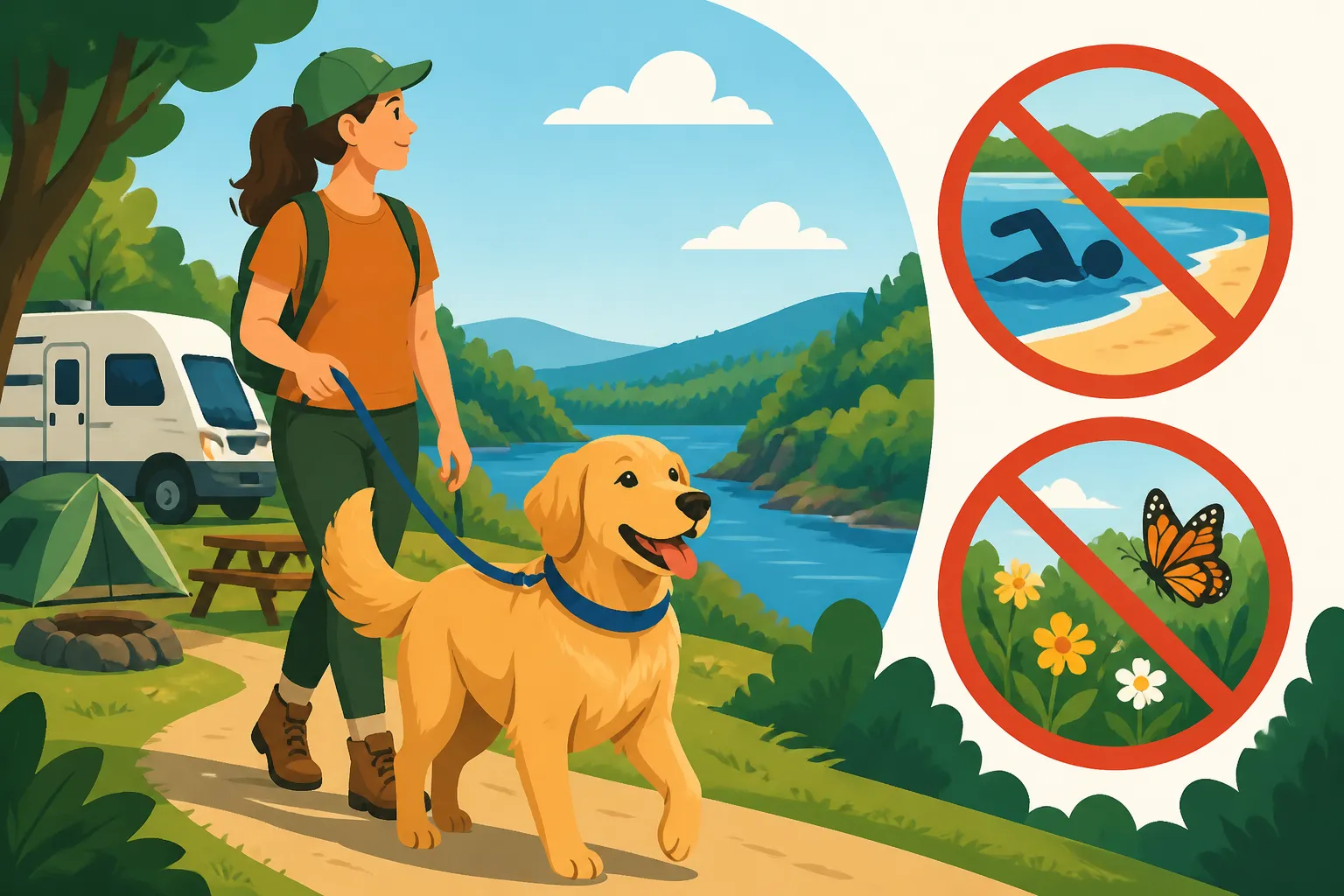
According to the Kentucky Department of Parks, pets are welcome at Kentucky State Parks, but must be leashed. Treat that as the baseline for any part of a park where your dog is permitted. A dog that is calm, well-trained, or accustomed to walking beside you still needs to be leashed.
The Kentucky Department of Parks also says pets are welcome in most outdoor areas but must be leashed, with restrictions in some locations. These statements fit together: a park can have many outdoor places where pets are allowed and still have particular areas that are off-limits. “Outdoor” is not a guarantee of access, and the rules for a campground, trail, beach, preserve, or historic site may differ.
The leash requirement is useful to keep in mind even while you are planning. It affects which routes are practical, what equipment to bring, and whether a planned outing will work for both your dog and the people with you. A long leash, for example, may be awkward on a narrow or busy path; the park’s current instructions and any posted signs should guide what you use. Do not assume that a verbal cue or reliable recall substitutes for a leash.
| Place or situation | What to plan around |
|---|---|
| Outdoor areas where pets are permitted | Keep your dog leashed and look for local restrictions |
| Nature preserves | Pets are restricted from nature preserves |
| Trails within State Nature Preserves | Pets are prohibited from these trails |
| Beaches | Pets are restricted from beaches |
| Some historic sites | Pets are restricted from some historic sites |
| A place with unclear or conflicting information | Check with the park through its official information before committing to the outing |
The table is a planning aid, not a complete map of every park’s pet rules. A park may have rules that depend on the specific area you plan to visit. Read the information for the park and the facility you intend to use, then follow signs when you arrive. If details are unclear, ask the park before relying on an assumption.
For a wider overview of pet access beyond the campground, see Taking a Leashed Dog Beyond the Campground at Kentucky State Parks. If your trip is centered on a specific property, a park-focused article can help you identify what to confirm for that location, but still check current park information before you go.
Keep access and behavior separate
A dog may be well behaved and still not be allowed in a particular place. Conversely, a place that allows pets does not remove the leash requirement. These are separate questions to settle:
- Is the dog allowed in this particular area?
- If allowed, must the dog remain leashed?
- Does the park identify any local restriction or access boundary?
- Is the place appropriate for your dog’s temperament, comfort, and stamina?
Thinking through both permission and practicality prevents a common planning mistake: choosing an outing because it appears open-air, then discovering that the intended area has a pet restriction.
Understand the no-go areas before choosing a route
The Kentucky Department of Parks states that pets are restricted from nature preserves, beaches, and some historic sites. It also states that pets are prohibited from trails within State Nature Preserves. Those are important distinctions when building a day around a hike, a shoreline stop, or a visit to a historic attraction.
The restriction on beaches is especially easy to overlook when a park trip includes lake or waterfront time. A dog may be allowed in some outdoor areas of the park without being permitted on the beach. Do not assume that access to a campground, picnic area, or nearby shoreline also gives your dog access to the beach itself. Check the specific area you plan to use. For more context, see Beaches, Preserves and Historic Sites: Where State Parks Bar Pets and Dogs at Lakeside Kentucky State Park Campgrounds: Beach Rules.
Nature preserves call for careful route planning as well. The broad restriction on nature preserves and the specific prohibition on trails within State Nature Preserves mean you should not plan to take a dog onto those trails. If a park visit includes a preserve, look for another activity or area where pets are allowed, rather than treating the preserve’s trail as a possible route.
Historic sites also need a location-by-location check. The wording is “some historic sites,” not all historic sites. That means neither assuming that every historic area excludes dogs nor assuming that an outdoor historic setting is open to pets is a sound plan. Confirm access for the particular site and any outdoor spaces connected with it.
Check the precise boundary, not just the park name
Park names can cover a variety of facilities and experiences. A campground, trailhead, beach, historic feature, picnic area, and nature preserve may all be associated with the same park, but they are not interchangeable when you are checking pet access. Look up the specific destination inside the park, not only the park’s general description.
If an online map or listing shows a path, shoreline, or attraction, that information alone does not establish that dogs are welcome there. Maps are useful for orientation, but they may not explain local restrictions. Cross-check pet access against official park information and posted signs.
If the restriction is unclear, ask before the trip rather than arriving with a plan that depends on uncertain access. A quick check can help you choose a different trail, find a suitable outdoor area, or decide whether a park is a good fit for your dog. Use the official park website to find current information and contact details.
Have a backup plan
A practical dog-friendly itinerary does not rely on access to a single trail or attraction. Identify an alternative activity in a permitted area in case your first choice is restricted, temporarily unavailable, or not suitable for your dog. That backup might be a different outdoor stop or a shorter visit to a place where pets are allowed.
This is especially helpful when other people in your group want to visit a preserve, beach, or historic site. They may be able to continue with that part of the visit while someone stays with the dog or takes the dog elsewhere, if the group’s plans allow. Do not bring a dog into an area where pets are prohibited simply to avoid splitting up.
Check the exact park and facility before you go
Use official park information to verify where dogs are allowed for your planned visit. Start with the park’s own pet guidance, then check information for the specific campground, trail, beach, historic site, or lodging you intend to use. General statements about pets do not answer every location-specific question.
A useful check covers more than the word “pets.” Look for the exact place name, any listed restrictions, and whether the information applies to the area you want to visit. If a page is brief or ambiguous, contact the park through details found on its official website. Ask a focused question, such as whether dogs may use a named trail or enter a particular outdoor facility.
You can also check for signs at the site when you arrive. A sign may clarify a restriction at an entrance or boundary. If the sign and an online summary appear to conflict, do not treat the more permissive interpretation as permission. Ask park staff for clarification before proceeding.
A visit-specific check is sensible because your plan may include more than the campground. For example, you might stay at a campsite, walk a trail, stop at a picnic area, and visit a historic feature. Confirm each part separately. Access to one part of the park does not necessarily answer the pet-access question for another.
For a property-specific example, Bringing a Dog to Natural Bridge: Trails, Lodge and Campground covers the kind of separate checks that can matter when a trip combines overnight lodging with outdoor activities. For picnic-area planning, see Leashed Dogs at Kentucky State Park Picnic Areas. Use such resources to shape your questions, then verify current details for the place you plan to visit.
Make a simple pre-trip check
Before leaving, write down the places you expect to visit and confirm pet access for each. A short plan can prevent confusion when the group reaches a trail junction or facility entrance. Include:
- The campground or lodging area where you will stay
- Any trail or outdoor route you plan to use
- Beaches or shoreline facilities you want to visit
- Historic sites or interpretive areas on your itinerary
- A backup location if a planned stop does not allow dogs
Keep the official park information accessible during the trip if possible. If plans change, check the new destination rather than assuming the original confirmation applies to the whole park. Ask about any area that is not clearly described.
Be cautious with old or unofficial information
A visitor’s comment, an old trip report, or a general map can help you understand what a place is like, but it should not be the final word on pet access. Restrictions may be posted for a specific facility or route, and a report about one area may not apply elsewhere in the park.
The safest approach is to use official park information for the decision and treat other descriptions as background. If the official information does not settle the question, contact the park before you make the activity part of your plans.
Plan campground time around your dog
Camping with a dog can make it easier to spend time outdoors, but a campsite does not automatically grant access to every nearby attraction. Keep your plans within places where dogs are permitted, and keep the dog leashed whenever it is in an allowed area. The same principle applies whether you are in a developed campground or using another type of park accommodation: check the rules for the specific place.
When comparing campgrounds, look beyond the basic question of whether camping is available. Consider where you will walk your dog, how close those routes are to your site, whether a desired trail or waterfront area has pet restrictions, and whether there is a reasonable alternative if your preferred route is unavailable. Choosing a Kentucky State Park for Your Camping Trip can help with the larger park-selection decision, while Kentucky State Park Campground Regulations, Rule by Rule is useful when you are reviewing campground expectations.
Do not assume that all campground features have identical pet access. A campground loop, bathhouse, store, picnic space, or beach may be treated differently. Check the specific facility instead of applying the campground’s general pet information to every nearby building or amenity.
Set the dog up for a manageable stay
Before booking or arriving, think about how your dog handles new sounds, nearby campers, wildlife, other dogs, and a changing routine. A park campground can be a busy environment. A dog that is comfortable in a quiet yard may respond differently to unfamiliar people passing close by or to the activity around neighboring sites.
Practical preparation can make the stay easier:
- Bring a leash suited to the walking conditions and your dog’s size.
- Pack water and familiar supplies so the dog can settle into the trip.
- Plan walks around the dog’s usual needs, while staying in permitted areas.
- Leave room in the itinerary for rest rather than expecting the dog to join every activity.
- Decide in advance who will stay with the dog if the group visits an area where pets are restricted.
These are planning suggestions, not additional park rules. Follow the park’s posted directions and ask about any requirement not covered in the information you have.
If you need help comparing site types, Tent, RV and Primitive Campgrounds Across Kentucky’s State Parks explains the broader camping choices. For details about what a campsite itself provides, What Every Kentucky State Park Campground Has, Water to Bathhouses may help you prepare, but check with the specific park about the facilities you intend to use.
Avoid treating the campsite as a place to leave the dog for every activity
An itinerary can become difficult if it assumes the dog can accompany the group everywhere or remain unattended while people go elsewhere. Before planning an activity that excludes pets, decide whether a responsible person can stay with the dog and whether the arrangement is workable for the dog. Do not assume that a park facility or lodging unit can serve as a substitute for a plan.
If your trip includes visits to a beach, preserve, or historic site, build the dog’s care into the schedule. The group may need to take turns, choose an alternate activity, or select a different destination. Making that decision before arrival is easier than improvising at a restricted entrance.
Choose trails and outdoor activities with care
The fact that pets are welcome in most outdoor areas does not mean every trail is open to dogs. The clearest restriction in the official information is that pets are prohibited from trails within State Nature Preserves. For trails elsewhere, check the specific route and follow posted directions. Do not assume that a trail is pet-friendly just because it is outside a building or appears on a park map.
When selecting a walk, consider both access and the dog’s ability to handle the route. Distance, surface, weather, crowding, and the dog’s condition all affect whether a walk is sensible. The park’s information can help you determine whether pets are allowed; you still need to judge whether the outing fits your dog.
A useful route-planning method is to identify the trail by name, confirm whether dogs may use it, and locate the access point before setting out. If the trail passes near a preserve, beach, or historic area, check whether the route enters a restricted zone. Do not rely on a vague trail description to decide where the boundary lies.
Make the walk work for the dog, not only the itinerary
Plan a walk that your dog can complete comfortably. A demanding route may not suit an older dog, a puppy, a dog recovering from an injury, or an animal that struggles with heat or crowds. Choose a shorter or less strenuous option if that better matches the dog’s needs.
Carry what you need to manage the outing without depending on a facility being open or close by. Bring water and a way to manage waste, and keep the dog leashed in permitted areas. Stop if the dog seems distressed or if conditions make the planned route unsafe. These are practical precautions, not substitutes for any direction from park staff.
For a trip that includes a lake, distinguish between general outdoor areas and beach access. The dog may be welcome in some outdoor places while being restricted from a beach. Check each intended stop. Lake Camping in Kentucky State Parks: Waterfront and Paddle-In Sites may help with broader waterfront planning, while the dog-specific beach article, Dogs at Lakeside Kentucky State Park Campgrounds: Beach Rules, is a useful prompt to verify access at your chosen location.
Be considerate around other visitors
Even where pets are allowed, a dog’s presence can affect people sharing the area. Keep enough control of the leash to respond if another visitor approaches, if the path narrows, or if the dog becomes excited. Give other visitors room where the setting permits, and do not expect people to interact with the dog.
A comfortable outing also depends on the dog’s reactions. If the dog becomes uneasy around unfamiliar people, bikes, children, or other animals, choose a quieter time or a less crowded route if the park’s schedule and access allow. If the dog is having difficulty settling, shorten the outing. A successful park trip does not require reaching every planned stop.
Check lodging and indoor access separately
If you are considering a cabin, cottage, or lodge stay, do not assume the outdoor pet policy answers the lodging question. Pet access to a room or rental is a separate matter that should be confirmed for the exact accommodation before you book. Check whether the property offers a pet-eligible option and ask about any conditions that apply to that unit.
The same caution applies to indoor dining and other buildings. A dog being welcome in many outdoor areas does not establish that it can enter a restaurant, visitor facility, or other indoor space. Verify the policy for the specific place rather than relying on a general park description. For help with lodging questions, see Your Pet in a Kentucky Resort Lodge Room or Cottage: The Rules and Pets and Indoor Dining at Kentucky State Parks.
This distinction can shape the whole trip. A dog-friendly campsite may work well if your activities are outdoors, while a lodge-centered visit may require more advance checking. If the property cannot confirm that the exact room or facility is suitable for your needs, consider another accommodation or plan to leave the dog out of those activities with a responsible person.
Ask specific questions before committing
When checking lodging, give the property enough detail to answer clearly. Identify the accommodation type you are considering and ask whether dogs are allowed in that specific unit. If you plan to use indoor dining or another facility, ask about that separately. Avoid interpreting a general “pets welcome” description as confirmation for every room or building.
Use the official park website to find current property information and contact details. Policies and available accommodations can differ by property, so a confirmation about one park should not be assumed to apply to another.
If you are traveling with an animal that may qualify as a service animal, do not assume that rules for household pets answer that question. Check the appropriate policy directly. Service Animals at Kentucky State Parks: Where Pet Rules Differ addresses why it is useful to distinguish these categories when asking about access.
A practical checklist for a smoother visit
A little preparation helps keep the trip flexible without turning it into a complicated project. The central tasks are to confirm where the dog may go, keep the leash requirement in mind, and avoid making the itinerary depend on access that has not been verified.
Before the trip:
- Choose the park and identify the areas you want to visit.
- Check pet access for each trail, beach, preserve, historic site, campground feature, and lodging option on your itinerary.
- Plan an alternate activity in case a location does not permit pets.
- Pack a leash, water, and supplies for your dog’s comfort and care.
- Decide how the group will handle any activity where the dog cannot accompany you.
- Use official park information to resolve unclear rules before leaving.
When you arrive:
- Read signs at entrances and area boundaries.
- Keep your dog leashed in places where pets are allowed.
- Do not take the dog onto trails within State Nature Preserves.
- Respect restrictions at beaches, nature preserves, and some historic sites.
- Ask park staff if signs or information leave a genuine uncertainty.
- Adjust the plan if the dog is tired, anxious, or uncomfortable.
During the visit, avoid treating a confirmed location as blanket permission for nearby areas. If you leave the campground for a trail, shoreline, picnic stop, or historic feature, check that destination on its own. The extra check is worthwhile because the park’s pet rules are not identical across every setting.
It can also help to make the dog’s limits part of the plan. A full day of walking and crowded stops may not suit every animal. Leave time for rest, choose activities that fit your dog, and keep an alternative ready if the dog is not coping well. A more modest itinerary can be better than trying to fit every attraction into the visit.
For related practical questions, Cleaning Up After Your Dog in a Kentucky State Park Campground can help you think through campground care, and Rules First-Time Visitors Miss at Kentucky State Parks offers broader preparation beyond pet access. Always confirm current requirements with the park itself.
Frequently Asked Questions
Can my dog be off leash if it stays close?
No. The Kentucky Department of Parks’ general rule requires pets to be leashed at all times where they are permitted. Good recall does not replace the leash requirement.
Are dogs allowed on every trail?
No. Dogs are prohibited from trails within State Nature Preserves. For other trails, check the specific route and follow posted information rather than assuming all trails allow pets.
Can I bring my dog to a state park beach?
Do not assume beach access. The Kentucky Department of Parks identifies beaches among the areas where pets are restricted. Confirm the rule for the particular beach before planning a visit.
Are dogs allowed at historic sites?
Some historic sites restrict pets. Check the exact site you intend to visit; the restriction does not mean every historic site has the same policy.
Does a pet-friendly campground mean the lodging is pet-friendly too?
Not necessarily. Confirm pet access for the specific room, cabin, cottage, or other accommodation, and check separately for indoor facilities such as dining areas.
Sources
- Kentucky Department of Parks — Explore Kentucky State Parks and Recreation |Nature's Playground Awaits! (checked November 23, 2026)
- Kentucky Department of Parks — FAQs – Kentucky State Parks (checked November 23, 2026)
Disclaimer
This article is for general informational purposes only and does not constitute professional advice. Laws, prices and regulations vary by location and change over time. Consult a qualified professional for guidance on your specific situation. Kentucky Camping & RV is not a government agency and is not affiliated with any government agency.